TMUA 2016 Paper 2: All 20 Questions

The 20 questions of the official TMUA 2016 Paper 2. The original paper and its worked answers are published free on the UAT-UK preparation page.

1

Find the value of

∫12(x2−4x2)2dx\int _{1}^{2}\left(x^{2} - \frac{4}{x^{2}}\right)^{2} dx
  1. A4315\displaystyle \frac{43}{15}
  2. B33
  3. C9715\displaystyle \frac{97}{15}
  4. D10315\displaystyle \frac{103}{15}
  5. E16315\displaystyle \frac{163}{15}
  6. F1818

2

f(x)=(x2+5)(2x)4x3\displaystyle f(x) = \frac{\left(x^{2} + 5\right)(2x)}{4\sqrt{x^{3}}}, x>0x > 0

Which one of the following is equal to f′(x)f'(x)?

  1. A8x94+403x14\displaystyle 8x^{\frac{9}{4}} + \frac{40}{3}x^{\frac{1}{4}}
  2. B92x54+52x−34\displaystyle \frac{9}{2}x^{\frac{5}{4}} + \frac{5}{2}x^{- \frac{3}{4}}
  3. C8x94+403x−14\displaystyle 8x^{\frac{9}{4}} + \frac{40}{3}x^{- \frac{1}{4}}
  4. D813x134+8x54\displaystyle \frac{8}{13}x^{\frac{13}{4}} + 8x^{\frac{5}{4}}

3

What is the value, in radians, of the largest angle xx in the range 0≤x≤2π0 \le x \le 2\pi that satisfies the equation 8sin⁡2x+4cos⁡2x=78\sin^{2} x + 4\cos^{2} x = 7?

  1. A2π3\displaystyle \frac{2\pi}{3}
  2. B5π6\displaystyle \frac{5\pi}{6}
  3. C4π3\displaystyle \frac{4\pi}{3}
  4. D5π3\displaystyle \frac{5\pi}{3}
  5. E7π4\displaystyle \frac{7\pi}{4}
  6. F11π6\displaystyle \frac{11\pi}{6}

4

Five sealed urns, labelled P, Q, R, S, and T, each contain the same (non-zero) number of balls. The following statements are attached to the urns.

Urn P This urn contains one or four balls.
Urn Q This urn contains two or four balls.
Urn R This urn contains more than two balls and fewer than five balls.
Urn S This urn contains one or two balls.
Urn T This urn contains fewer than three balls.

Exactly one of the urns has a true statement attached to it.

Which urn is it?

  1. AUrn P
  2. BUrn Q
  3. CUrn R
  4. DUrn S
  5. EUrn T

5

Consider the statement:

(∗)(*) A whole number nn is prime if it is 11 less or 55 less than a multiple of 66.

How many counterexamples to (∗)(*) are there in the range 0<n<500 < n < 50?

  1. A22
  2. B33
  3. C44
  4. D55
  5. E66

6

The sequence of functions f1(x)f_{1}(x), f2(x)f_{2}(x), f3(x)f_{3}(x), …\ldots is defined as follows:

f1(x)=x10f_{1}(x) = x^{10}

fn+1(x)=xfn′(x)f_{n+1}(x) = xf'_{n}(x) for n≥1n \ge 1

where fn′(x)=dfn(x)dx\displaystyle f'_{n}(x) = \frac{df_{n}(x)}{dx}

Find the value of

∑n=120fn(x)\sum _{n=1}^{20} f_{n} (x)
  1. Ax10(x20−1)x−1\displaystyle \frac{x^{10}\left(x^{20} - 1\right)}{x - 1}
  2. Bx10(x21−1)x−1\displaystyle \frac{x^{10}\left(x^{21} - 1\right)}{x - 1}
  3. C(1020−19)x10\displaystyle \left(\frac{10^{20} - 1}{9}\right)x^{10}
  4. D(1021−19)x10\displaystyle \left(\frac{10^{21} - 1}{9}\right)x^{10}
  5. E((10x)20−110x−1)x10\displaystyle \left(\frac{(10x)^{20} - 1}{10x - 1}\right)x^{10}
  6. F((10x)21−110x−1)x10\displaystyle \left(\frac{(10x)^{21} - 1}{10x - 1}\right)x^{10}
  7. Gx10+x9+x8+⋯+x+1x^{10} + x^{9} + x^{8} + \cdots + x + 1
  8. Hx10+10x9+(10×9)x8+⋯+(10×9×…×2)x+(10×9×…×2×1)x^{10} + 10x^{9} + (10 \times 9)x^{8} + \cdots + (10 \times 9 \times \ldots \times 2)x + (10 \times 9 \times \ldots \times 2 \times 1)

7

The four real numbers a,b,ca,b,c, and dd are all greater than 11.

Suppose that they satisfy the equation log⁡cd=(log⁡ab)2\log_{c} d = (\log_{a} b)^{2}.

Use some of the lines given to construct a proof that, in this case, it follows that

(∗)log⁡bd=(log⁡ab)(log⁡ac)(*) \log_{b} d = (\log_{a} b)(\log_{a} c).

(1)(1) Let x=log⁡abx = \log_{a} b and y=log⁡acy = \log_{a} c

(2)d=(cx)2(2) d = \left(c^{x}\right)^{2}
(3)d=c(x2)(3) d = c^{\left(x^{2}\right)}
(4)d=bxy(4) d = b^{xy}

(5)d=(ay)(x2)(5) d = \left(a^{y}\right)^{\left(x^{2}\right)}
(6)d=((ay)x)2(6) d = \left(\left(a^{y}\right)^{x}\right)^{2}
(7)d=(ax)xy(7) d = \left(a^{x}\right)^{xy}

(8)d=a(y2x)(8) d = a^{\left(y^{2x}\right)}
(9)d=a(x2y)(9) d = a^{\left(x^{2}y\right)}

  1. A(1)(1). Then (2)(2), so (6)(6), so (8)(8), so (7)(7), and therefore (4)(4), hence (∗)(*) as required.
  2. B(1)(1). Then (2)(2), so (7)(7), so (8)(8), so (6)(6), and therefore (4)(4), hence (∗)(*) as required.
  3. C(1)(1). Then (3)(3), so (5)(5), so (9)(9), so (7)(7), and therefore (4)(4), hence (∗)(*) as required.
  4. D(1)(1). Then (3)(3), so (7)(7), so (9)(9), so (5)(5), and therefore (4)(4), hence (∗)(*) as required.
  5. E(1)(1). Then (4)(4), so (5)(5), so (9)(9), so (7)(7), and therefore (3)(3), hence (∗)(*) as required.
  6. F(1)(1). Then (4)(4), so (6)(6), so (8)(8), so (7)(7), and therefore (2)(2), hence (∗)(*) as required.
  7. G(1)(1). Then (4)(4), so (7)(7), so (8)(8), so (6)(6), and therefore (2)(2), hence (∗)(*) as required.
  8. H(1)(1). Then (4)(4), so (7)(7), so (9)(9), so (5)(5), and therefore (3)(3), hence (∗)(*) as required.

8

A region is defined by the inequalities x+y>6x + y > 6 and x−y>−4x - y > -4

Consider the three statements:

1x>11 x > 1
2y>52 y > 5
3(x+y)(x−y)>−243 (x + y)(x - y) > -24

Which of the above statements is/are true for every point in the region?

  1. Anone
  2. B11 only
  3. C22 only
  4. D33 only
  5. E11 and 22 only
  6. F11 and 33 only
  7. G22 and 33 only
  8. H11, 22 and 33

9

Triangles ABCABC and XYZXYZ have the same area.

Which of these extra conditions, taken independently, would imply that they are congruent?

(1)AB=XY(1) AB = XY and BC=YZBC = YZ

(2)AB=XY(2) AB = XY and ∠ABC=∠XYZ\angle ABC = \angle XYZ

(3)∠ABC=∠XYZ(3) \angle ABC = \angle XYZ and ∠BCA=∠YZX\angle BCA = \angle YZX

  1. ACondition (1)(1): Does not imply congruent; Condition (2)(2): Does not imply congruent; Condition (3)(3): Does not imply congruent
  2. BCondition (1)(1): Does not imply congruent; Condition (2)(2): Does not imply congruent; Condition (3)(3): Implies congruent
  3. CCondition (1)(1): Does not imply congruent; Condition (2)(2): Implies congruent; Condition (3)(3): Does not imply congruent
  4. DCondition (1)(1): Does not imply congruent; Condition (2)(2): Implies congruent; Condition (3)(3): Implies congruent
  5. ECondition (1)(1): Implies congruent; Condition (2)(2): Does not imply congruent; Condition (3)(3): Does not imply congruent
  6. FCondition (1)(1): Implies congruent; Condition (2)(2): Does not imply congruent; Condition (3)(3): Implies congruent
  7. GCondition (1)(1): Implies congruent; Condition (2)(2): Implies congruent; Condition (3)(3): Does not imply congruent
  8. HCondition (1)(1): Implies congruent; Condition (2)(2): Implies congruent; Condition (3)(3): Implies congruent

10

In this question xx and yy are non-zero real numbers.

Which one of the following is sufficient to conclude that x<yx < y?

  1. Ax4<y4x^{4} < y^{4}
  2. By4<x4y^{4} < x^{4}
  3. Cx−1<y−1x^{-1} < y^{-1}
  4. Dy−1<x−1y^{-1} < x^{-1}
  5. Ex35<y35\displaystyle x^{\frac{3}{5}} < y^{\frac{3}{5}}
  6. Fy35<x35\displaystyle y^{\frac{3}{5}} < x^{\frac{3}{5}}

11

f(x)f(x) is a polynomial with real coefficients.

The equation f(x)=0f(x) = 0 has exactly two real roots, x=−px = -p and x=px = p, where p>0p > 0.

Consider the following three statements:

1f′(x)=01 f'(x) = 0 for exactly one value of xx between −p-p and pp

22 The area between the curve y=f(x)y = f(x), the xx-axis and the lines x=−px = -p and x=px = p is given by 2∫0pf(x)dx\displaystyle 2\int _{0}^{p}f(x) dx
33 The graph of y=−f(−x)y = -f(-x) intersects the xx-axis at the points x=−px = -p and x=px = p only

Which of the above statements must be true?

  1. Anone
  2. B11 only
  3. C22 only
  4. D33 only
  5. E11 and 22 only
  6. F11 and 33 only
  7. G22 and 33 only
  8. H11, 22 and 33

12

The first term of an arithmetic sequence is aa and the common difference is dd.

The sum of the first nnterms is denoted by SnS_{n}.

If S8>3S6S_{8} > 3S_{6}, what can be deduced about the sign of aa and the sign of dd?

  1. Aboth aa and dd are negative
  2. Baa is positive, dd is negative
  3. Caa is negative, dd is positive
  4. Daa is negative, but the sign of dd cannot be deduced
  5. Edd is negative, but the sign of aa cannot be deduced
  6. Fneither the sign of aa nor the sign of dd can be deduced

13

In this question, aa, bb, and cc are positive integers.

The following is an attempted proof of the false statement:

If aa divides bcbc, then aa divides bb or aa divides cc.

[′a['a divides bc′bc' means ′a'a is a factor of bc′]bc']

Which line contains the error in this proof?

11. The statement is equivalent to ‘if aa does not divide bb and aa does not divide cc then aa does not divide bc′bc'.
22. Suppose aa does not divide bb and aa does not divide cc. Then the remainder when dividing bb by aa is rr, where 0<r<a0 < r < a, and the remainder when dividing cc by aa is ss, where 0<s<a0 < s < a.
33. So b=ax+rb = ax + r and c=ay+sc = ay + s for some integers xx and yy. 44. Thus bc=a(axy+xs+yr)+rsbc = a(axy + xs + yr) + rs.
55. So the remainder when dividing bcbc by aa is rsrs.
66. Since r>0r > 0 and s>0s > 0, it follows that rs>0rs > 0.
77. Hence aa does not divide bcbc.

  1. ALine 11
  2. BLine 22
  3. CLine 33
  4. DLine 44
  5. ELine 55
  6. FLine 66

14

f(x)=ax4+bx3+cx2+dx+ef(x) = ax^{4} + bx^{3} + cx^{2} + dx + e, where aa, bb, cc, dd, and ee are real numbers.

Suppose f(x)=1f(x) = 1 has pp distinct real solutions, f(x)=2f(x) = 2 has qq distinct real solutions, f(x)=3f(x) = 3 has rr distinct real solutions, and f(x)=4f(x) = 4 has ss distinct real solutions.

Which one of the following is not possible?

  1. Ap=1p = 1, q=2q = 2, r=4r = 4 and s=3s = 3
  2. Bp=1p = 1, q=3q = 3, r=2r = 2 and s=4s = 4
  3. Cp=1p = 1, q=4q = 4, r=3r = 3 and s=2s = 2
  4. Dp=2p = 2, q=4q = 4, r=3r = 3 and s=1s = 1
  5. Ep=4p = 4, q=3q = 3, r=2r = 2 and s=1s = 1

15

Consider the quadratic f(x)=x2−2px+qf(x) = x^{2} - 2px + q and the statement:

(∗)f(x)=0(*) f(x) = 0 has two real roots whose difference is greater than 22 and less than 44.

Which one of the following statements is true if and only if (∗)(*) is true?

  1. Aq<p2<q+4q < p^{2} < q + 4
  2. Bq+1<p<q+4\sqrt{q + 1} < p < \sqrt{q + 4}
  3. Cq−3≤p2−4≤qq - 3 \le p^{2} - 4 \le q
  4. Dq<p2−1<q+3q < p^{2} - 1 < q + 3
  5. Eq−2<p2−3<q+2q - 2 < p^{2} - 3 < q + 2

16

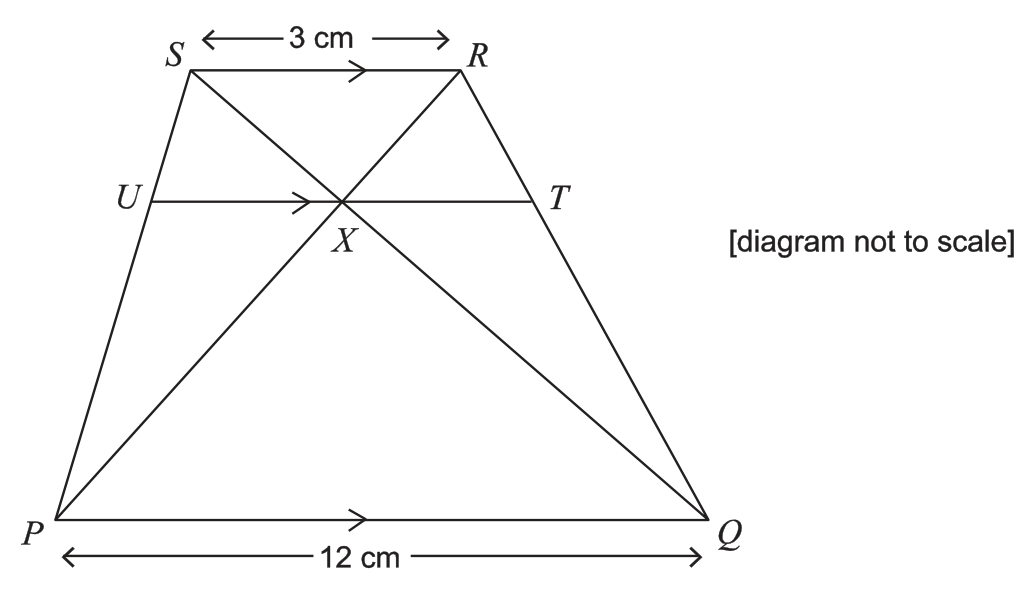
Figure

In the figure, PQRSPQRS is a trapezium with PQPQ parallel to SRSR.

The diagonals of the trapezium meet at XX.

UU lies on SPSP and TT lies on RQRQ such that UTUT is a line segment through XX parallel to PQPQ.

The length of PQPQ is 1212 cm and the length of SRSR is 33 cm.

What, in centimetres, is the length of UTUT?

  1. A4.24.2
  2. B4.54.5
  3. C4.84.8
  4. D5.255.25
  5. E66

17

Consider these simultaneous equations, where cc is a constant:

y=3sin⁡x+2y = 3\sin x + 2
y=x+cy = x + c

Which of the following statements is/are true?

11 For some value of cc: there is exactly one solution with 0≤x≤π0 \le x \le \pi and there is at least one solution with −π<x<0-\pi < x < 0.
22 For some value of cc: there is exactly one solution with 0≤x≤π0 \le x \le \pi and there are no solutions with −π<x<0-\pi < x < 0.
33 For some value of cc: there is exactly one solution with 0≤x≤π0 \le x \le \pi and there are no solutions with x>πx > \pi.

  1. Anone
  2. B11 only
  3. C22 only
  4. D33 only
  5. E11 and 22 only
  6. F11 and 33 only
  7. G22 and 33 only
  8. H11, 22 and 33

18

Consider this statement about a function f(x)f(x):

(∗)(*) If (f(x))2≤1(f(x))^{2} \le 1 for all −1≤x≤1-1 \le x \le 1 then ∫−11(f(x))2dx≤∫−11f(x)dx\displaystyle \int _{-1}^{1}(f(x))^{2} dx \le \int _{-1}^{1}f(x)dx

Which one of the following functions provides a counterexample to (∗)(*)?

  1. Af(x)=x+12\displaystyle f(x) = x + \frac{1}{2}
  2. Bf(x)=x−12\displaystyle f(x) = x - \frac{1}{2}
  3. Cf(x)=x+x3f(x) = x + x^{3}
  4. Df(x)=x−x3f(x) = x - x^{3}
  5. Ef(x)=x2+x4f(x) = x^{2} + x^{4}
  6. Ff(x)=x2−x4f(x) = x^{2} - x^{4}

19

Some identical unit cubes are used to construct a three-dimensional object by gluing them together face to face.

Sketches of this object are made by looking at it from the right-hand side, from the front and from above. These sketches are called the side elevation, the front elevation, and the plan view respectively.

This is the side elevation of the object.
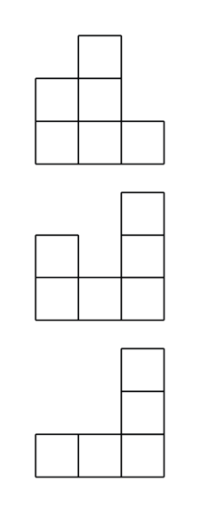
Figure

This is the front elevation of the object.

This is the plan view of the object.

How many cubes were used to construct the object?

  1. Aexactly 66
  2. Beither 66 or 77
  3. Cexactly 77
  4. Deither 77 or 88
  5. Eexactly 88
  6. Feither 88 or 99
  7. Gexactly 99

20

Each interior angle of a regular polygon with nn sides is 34\displaystyle \frac{3}{4} of each interior angle of a second regular polygon with mm sides.

How many pairs of positive integers nn and mm are there for which this statement is true?

  1. Anone
  2. B11
  3. C22
  4. D33
  5. E44
  6. F55
  7. G66
  8. Hinfinitely many

These are free. The full document, 208 pages across the typeset edition and the original handwritten manuscript, is NOIR PREMIERE.

Live now

The lecture has started

Free, on Google Meet.