TMUA 2021 Paper 1: All 20 Questions

The 20 questions of the official TMUA 2021 Paper 1. The original paper and its worked answers are published free on the UAT-UK preparation page.

1

Two circles have the same radius.

The centre of one circle is (−2(-2, 1)1).

The centre of the other circle is (3(3, −2)-2).

The circles intersect at two distinct points.

What is the equation of the straight line through the two points at which the circles intersect?

  1. A3x−5y=43x - 5y = 4
  2. B3x+5y=−13x + 5y = -1
  3. C5x−3y=−45x - 3y = -4
  4. D5x−3y=−15x - 3y = -1
  5. E5x−3y=15x - 3y = 1
  6. F5x−3y=45x - 3y = 4
  7. G5x+3y=15x + 3y = 1

2

The curve y=x3−6x+3y = x^{3} - 6x + 3 has turning points at x=αx = \alpha and x=βx = \beta, where β>α\beta > \alpha.

Find

∫αβx3−6x+3dx\int _{\alpha}^{\beta} x^{3} - 6x + 3 dx
  1. A−82-8\sqrt{2}
  2. B−10-10
  3. C−10+62-10 + 6\sqrt{2}
  4. D00
  5. E12−8212 - 8\sqrt{2}
  6. F626\sqrt{2}
  7. G1212

3

An arithmetic progression and a convergent geometric progression each have first term 12\displaystyle \frac{1}{2}

The sum of the second terms of the two progressions is 12\displaystyle \frac{1}{2}

The sum of the third terms of the two progressions is 18\displaystyle \frac{1}{8}

What is the sum to infinity of the geometric progression?

  1. A−2-2
  2. B−1-1
  3. C−12\displaystyle -\frac{1}{2}
  4. D−13\displaystyle -\frac{1}{3}
  5. E13\displaystyle \frac{1}{3}
  6. F12\displaystyle \frac{1}{2}
  7. G11
  8. H22

4

Find the minimum value of the function

22x−2x+3+42^{2x} - 2^{x+3} + 4
  1. A−16-16
  2. B−12-12
  3. C−8-8
  4. D00
  5. E44
  6. F2020

5

The function f is such that

f(m)f(n)f(m)f(n) if mnmn is a multiple of 33

f(mn)={f(mn) = \{

mnmn if mnmn is not a multiple of 33

for all positive integers mm and nn.

Given that f(9) ++ f(16) −- f(24) =0= 0, what is the value of f(3)?

  1. A83\displaystyle \frac{8}{3}
  2. B222\sqrt{2}
  3. C33
  4. D165\displaystyle \frac{16}{5}
  5. E323\sqrt{2}
  6. F44

6

The function f is given by

f(x)=cos⁡x+37+5cos⁡x−sin⁡2xf(x) = \frac{\cos x + 3}{7 + 5\cos x - \sin^{2} x}

Find the positive difference between the maximum and the minimum values of f(x)f(x).

  1. A00
  2. B13\displaystyle \frac{1}{3}
  3. C12\displaystyle \frac{1}{2}
  4. D23\displaystyle \frac{2}{3}
  5. E11
  6. F22

7

The function f is such that f(0) =0= 0, and xf(x)>0xf(x) > 0 for all non-zero values of xx.

It is given that

∫−22f(x)dx=4\int _{-2}^{2} f(x) dx = 4

and

∫−22∣f(x)∣dx=8\int _{-2}^{2} |f(x)| dx = 8

Evaluate

∫−20f(∣x∣)dx\int _{-2}^{0} f(|x|) dx
  1. A−8-8
  2. B−6-6
  3. C−4-4
  4. D−2-2
  5. E22
  6. F44
  7. G66
  8. H88

8

The line y=2x+3y = 2x + 3 meets the curve y=x2+bx+cy = x^{2} + bx + c at exactly one point.

The line y=4x−2y = 4x - 2 also meets the curve y=x2+bx+cy = x^{2} + bx + c at exactly one point.

What is the value of b−cb - c?

  1. A−9-9
  2. B−5.5-5.5
  3. C−1-1
  4. D55
  5. E66
  6. F1414

9

Find the area enclosed by the graph of

∣x∣+∣y∣=1|x| + |y| = 1
  1. A12\displaystyle \frac{1}{2}
  2. B11
  3. C22
  4. D44
  5. E122\displaystyle \frac{1}{2}\sqrt{2}
  6. F2\sqrt{2}
  7. G222\sqrt{2}

10

Use the trapezium rule with 33 strips to estimate

∫1222log⁡10xdx\int _{\frac{1}{2}}^{2} 2\log_{10} x dx
  1. Alog⁡1062\displaystyle \log_{10} \frac{\sqrt{6}}{2}
  2. Blog⁡1032\displaystyle \log_{10} \frac{3}{2}
  3. Clog⁡1094\displaystyle \log_{10} \frac{9}{4}
  4. Dlog⁡103\log_{10} 3
  5. Elog⁡108116\displaystyle \log_{10} \frac{81}{16}
  6. Flog⁡10232\displaystyle \log_{10} \frac{\sqrt{23}}{2}

11

The function f is given by

f(x)=x17(x2−x+1)f(x) = x^{\frac{1}{7}}\left(x^{2} - x + 1\right)

Find the fraction of the interval 0<x<10 < x < 1 for which f(x)f(x) is decreasing.

  1. A215\displaystyle \frac{2}{15}
  2. B15\displaystyle \frac{1}{5}
  3. C13\displaystyle \frac{1}{3}
  4. D12\displaystyle \frac{1}{2}
  5. E23\displaystyle \frac{2}{3}
  6. F45\displaystyle \frac{4}{5}
  7. G1315\displaystyle \frac{13}{15}

12

The minimum value of the function x4−p2x2x^{4} - p^{2}x^{2} is −9-9

pp is a real number.

Find the minimum value of the function x2−px+6x^{2} - px + 6

  1. A−3-3
  2. B6−322\displaystyle 6 - \frac{3\sqrt{2}}{2}
  3. C32\displaystyle \frac{3}{2}
  4. D33
  5. E92\displaystyle \frac{9}{2}
  6. F6+322\displaystyle 6 + \frac{3\sqrt{2}}{2}

13

The function f is such that, for every integer nn

∫nn+1f(x)dx=n+1\int _{n}^{n+1} f(x) dx = n + 1

Evaluate

∑r=18(∫0rf(x)dx)\sum _{r=1}^{8}\left(\int _{0}^{r} f(x) dx\right)
  1. A3636
  2. B8484
  3. C120120
  4. D165165
  5. E204204
  6. F288288

14

This question uses radians.

Find the number of distinct values of xx that satisfy the equation

(x+1)(3−x)=2(1−cos⁡(πx))(x + 1)(3 - x) = 2(1 - \cos (\pi x))
  1. A22
  2. B33
  3. C44
  4. D55
  5. E66
  6. F77

15

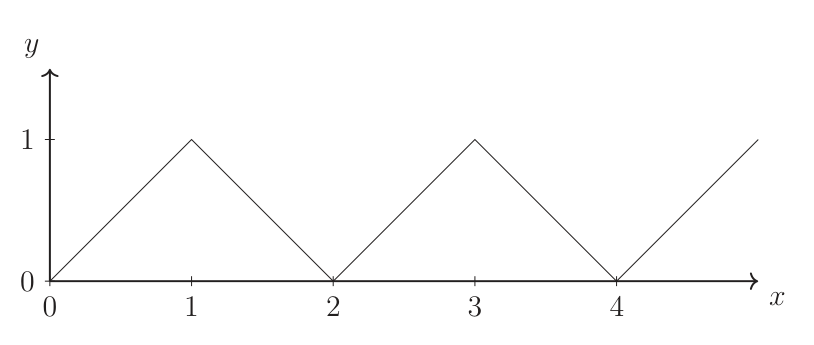
The diagram shows the graph of y=f(x)y = f(x).

Figure

The graph consists of alternating straight-line segments of gradient 11 and −1-1 and continues in this way for all values of xx.

The function g is defined as

g(x)=∑r=110f2r−1xg(x) = \sum _{r=1}^{10}f 2^{r-1}x

Find the value of

∫01g(x)dx\int _{0}^{1} g(x) dx
  1. A10231024\displaystyle \frac{1023}{1024}
  2. B1023512\displaystyle \frac{1023}{512}
  3. C55
  4. D1010
  5. E552\displaystyle \frac{55}{2}
  6. F5555

16

Consider the expansion of

(a+bx)n(a + bx)^{n}

The third term, in ascending powers of xx, is 105x2105x^{2}

The fourth term, in ascending powers of xx, is 210x3210x^{3}

The fourth term, in descending powers of xx, is 210x3210x^{3}

Find the value of ab2\displaystyle \frac{a}{b}^{2}

  1. A14\displaystyle \frac{1}{4}
  2. B49\displaystyle \frac{4}{9}
  3. C2536\displaystyle \frac{25}{36}
  4. D56\displaystyle \frac{5}{6}
  5. E11

17

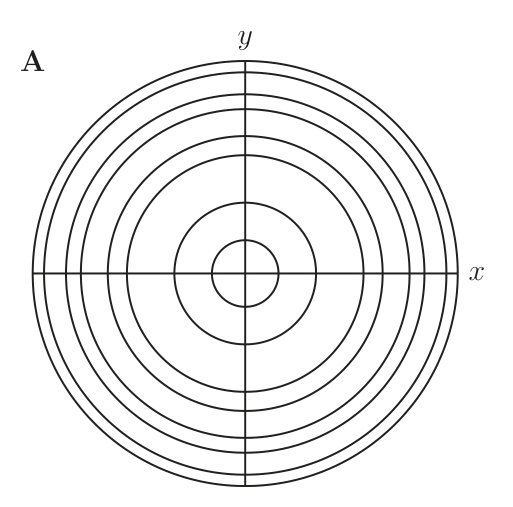
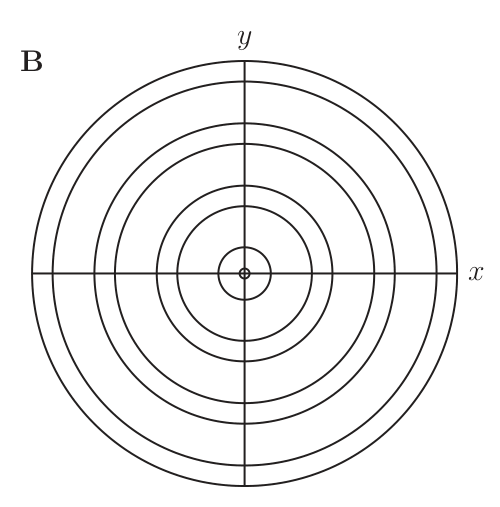
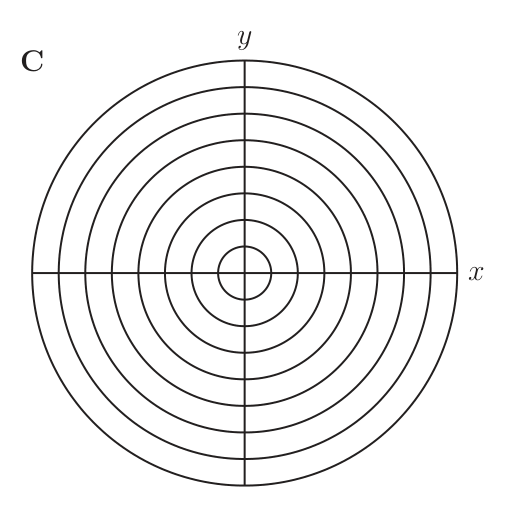
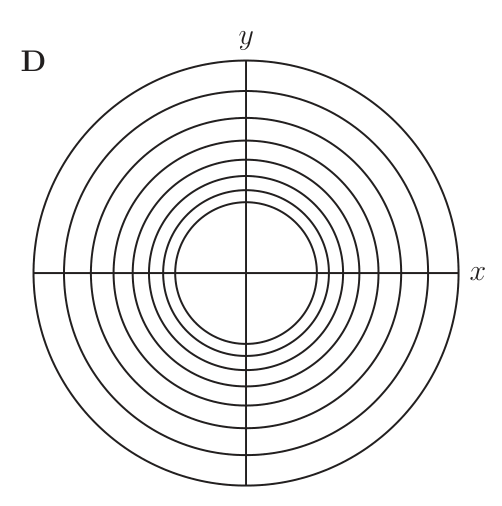
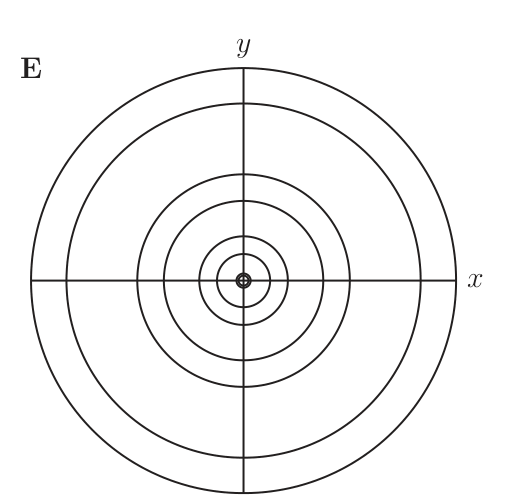
Which of the following sketches shows the graph of

sin⁡(x2+y2)=12\sin \left(x^{2} + y^{2}\right) = \frac{1}{2}

where x2+y2≤8πx^{2} + y^{2} \le 8\pi?

FigureFigureFigureFigureFigure
  1. AGraph A
  2. BGraph B
  3. CGraph C
  4. DGraph D
  5. EGraph E

18

The curve with equation

x=y2−6y+11x = y^{2} - 6y + 11

is rotated 90o90^{o} clockwise about the point PP to give the curve CC.

PP has xx-coordinate −2-2 and yy-coordinate 33.

What is the equation of CC?

  1. Ay=−x2−4x−3y = -x^{2} - 4x - 3
  2. By=−x2−4x−5y = -x^{2} - 4x - 5
  3. Cy=−x2−6x−7y = -x^{2} - 6x - 7
  4. Dy=−x2−6x−11y = -x^{2} - 6x - 11
  5. Ey=x2−4x+5y = x^{2} - 4x + 5
  6. Fy=x2+4x+3y = x^{2} + 4x + 3
  7. Gy=x2−6x+11y = x^{2} - 6x + 11
  8. Hy=x2+6x+7y = x^{2} + 6x + 7

19

The equation

sin⁡24cos⁡θ×60o=34\sin^{2} 4^{\cos \theta} \times 60^{o} = \frac{3}{4}

has exactly three solutions in the range 0o≤θ≤xo0^{o} \le \theta \le x^{o}

What is the range of all possible values of xx?

  1. A90≤x<12090 \le x < 120
  2. B90≤x<27090 \le x < 270
  3. C120≤x<240120 \le x < 240
  4. D270≤x<300270 \le x < 300
  5. E300≤x<360300 \le x < 360
  6. F450≤x<630450 \le x < 630

20

Find the length of the curve with equation

2log⁡10(x−y)=log⁡10(2−2x)+log⁡10(y+5)2\log_{10} (x - y) = \log_{10} (2 - 2x) + \log_{10} (y + 5)
  1. A55
  2. B1010
  3. C1515
  4. D3π3\pi
  5. E9π9\pi
  6. F12π12\pi

These are free. The full document, 208 pages across the typeset edition and the original handwritten manuscript, is NOIR PREMIERE.

Live now

The lecture has started

Free, on Google Meet.